All work

Global Patient Care
Operations Platform

An enterprise workspace for coordinating patient-support programmes - connecting care access, vendor delivery, safety review, and operational accountability in one flow.

Project
Roche PCS
Client
Roche
Industry
Healthcare
Product Type
B2B | Enterprise Healthcare
Platform
Web Application
My Role
UX Lead
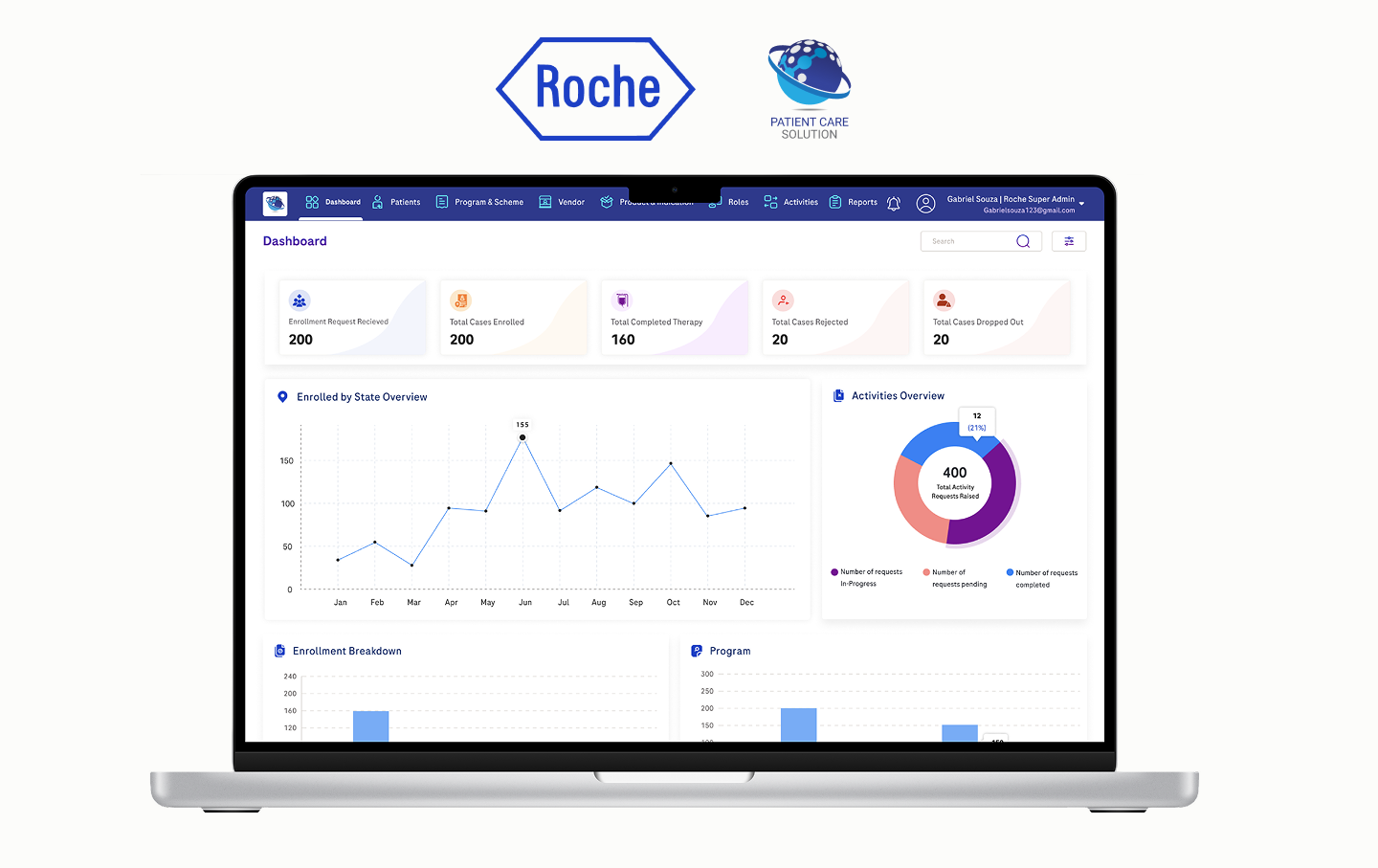
Roche Patient Care Solution operations dashboard shown on a laptop

Research and Discovery

Competitor analysis: where PCS fits.

Discovery began by comparing four groups of patient-support providers and the parts of the journey they already addressed. PCS brought access, safety review, and service delivery together in a shared operating model across organisations and markets.

US hub providers

CareMetx · AssistRx · Lash Group · PharmaCord · ConnectiveRx · Phil

What is already solved

Combine programme delivery with software: enrolment, benefits verification, prior authorisation, copay support, and visibility into access to therapy.

Gap for this programme

A strong US reimbursement focus and reliance on staff to coordinate work require adaptation where delivery and adherence are the central challenges.

Where Roche PCS stands

PCS focuses on access, home administration, and service delivery, coordinating independent organisations through a shared programme record.
Enterprise life-sciences platforms

Veeva · IQVIA · Salesforce Life Sciences Cloud

What is already solved

Provide broad CRM, data, analytics, and governance capabilities for large organisations and multi-country operations.

Gap for this programme

Adapting a broad platform to a specific patient-services operating model adds implementation, validation, and configuration overhead.

Where Roche PCS stands

PCS centres the everyday programme workflow: patient records, service tasks, approvals, and role-based access across companies.

Purpose-built PSP vendors

Zelthy · Calian (Nexi) · Medisafe · Careform

What is already solved

Offer programme templates, case-management workflows, engagement, and adherence tools, providing a faster route to deployment when those templates fit the programme.

Gap for this programme

Speed alone does not establish fit for this programme. Cross-company permissions, approval ownership, and market-specific service rules still need to be evaluated.

Where Roche PCS stands

PCS makes a reusable task model and configurable market layer central to the design. These vendors remain relevant alternatives, rather than a capability gap assumed away.

Regional service operators

Axios International · Alira Health · Inizio · Local distributors and nursing vendors

What is already solved

Bring local patient relationships, service delivery, and operational knowledge, often supported by their own coordination tools.

Gap for this programme

Work crosses company boundaries. Separate tools, email, phone calls, and shared drives make the next owner and the latest status harder to follow.

Where Roche PCS stands

PCS connects the operator, delivery vendor, safety function, and Roche through a common workflow while preserving each role’s visibility and responsibility.

6 of 12

Mapped steps took place outside the platform.

The gap appeared in the hand-offs.

Before the redesign, home administration relied on email for documents, phone calls for appointments, and a shared drive for files. PCS made responsibility, approval status, and the next action visible across those organisational boundaries.

Starting point: the home-administration workflow mapped during discovery.

Three approval gates shape the service.

  1. 1 / Programme operator

    Eligibility

    Confirm that the patient qualifies for the programme.

  2. 2 / Pharmacovigilance

    Safety

    Review documentation for potential adverse-event information.

  3. 3 / Roche

    Commercial

    Approve the vendor cost before service fulfilment.

A shared workflow, not a single-team tool

Roche, programme operators, service vendors, and pharmacovigilance each need a clear part in one patient journey - without exposing more than their role requires.

Safety can surface anywhere

An adverse-event signal can originate in a note, a document, or a support interaction. The product needs an accountable route from every touchpoint to review.

One global service, many local realities

Vendors, available services, consent, languages, reporting routes, and data handling vary by market. The platform cannot treat local context as an edge case.

Architecture

A common core. Local control where it matters.

The central product question was not simply what to build. It was where an operational rule belongs: in the durable global service model, or in a market-level configuration.

Global core

Built once.
Shared everywhere.

The same foundation keeps patient records, tasks, and accountability consistent across every programme.

  • Patient record & lifecycle
  • Task engine & notifications
  • Role-based access
  • Approval routing & audit trail

Market configuration

Adapted locally.
Connected globally.

Each market adds its partners, service rules, and local requirements to that shared foundation.

  • Service catalogue & vendors
  • Approval-chain composition
  • Language & consent content
  • Privacy, residency & PV routing
One shared coreLocal configurationOne connected care platform

One patient, many services.

The programme record connects each patient’s service history. A generic task engine supports sixteen task types, so services such as home administration, delivery, and adherence follow-up share the same underlying model.

Configure the market. Preserve the workflow.

Nursing, logistics, and distribution vendors are configured alongside service availability and approval ownership. Consent, language, data residency, and safety-reporting routes form the local compliance configuration.

Regulation

Safety runs through every interaction.

Drug-safety review shaped the operating model. A phone note, uploaded document, or feedback entry can contain a potential adverse-event signal, so the workflow needs a clear route to pharmacovigilance and a timestamped record of the hand-off.

  1. 1 / Capture

    Keep the information and its origin attached to the programme record.

  2. 2 / Route

    Send potential safety information to the responsible pharmacovigilance team.

  3. 3 / Trace

    Make ownership, status changes, and reasons visible in the audit trail.

Data protection shapes the market layer.

The design accommodates regional requirements through consent content, access controls, retention settings, and data-handling rules. These are configuration dimensions for each rollout.

Belgium / EU
GDPR
Sensitive health information, role-based access, and documented data flows.
Canada
PIPEDA · Quebec Law 25
Federal and provincial requirements reflected in local privacy settings.
Brazil
LGPD
Local consent and data-handling requirements within the shared workflow.
India
DPDP Act & Rules
Market-specific consent, permissions, and retention configuration.
Malaysia · Indonesia
PDPA · PDP Law
Local accountability and incident-handling processes.
Other markets
Local privacy frameworks
Language, consent, safety routing, and access rules adapted per market.

The patient relationship shapes permissions.

Where direct pharmaceutical-company contact is restricted, the programme operator remains the patient’s point of contact. The role model separates patient-facing service delivery from Roche’s commercial approvals and programme oversight.

Screen deep dives

Different roles. Connected care.

Seven product views show how role-specific workspaces make patient context, responsibilities, and next actions easier to navigate.

Select a screen to explore

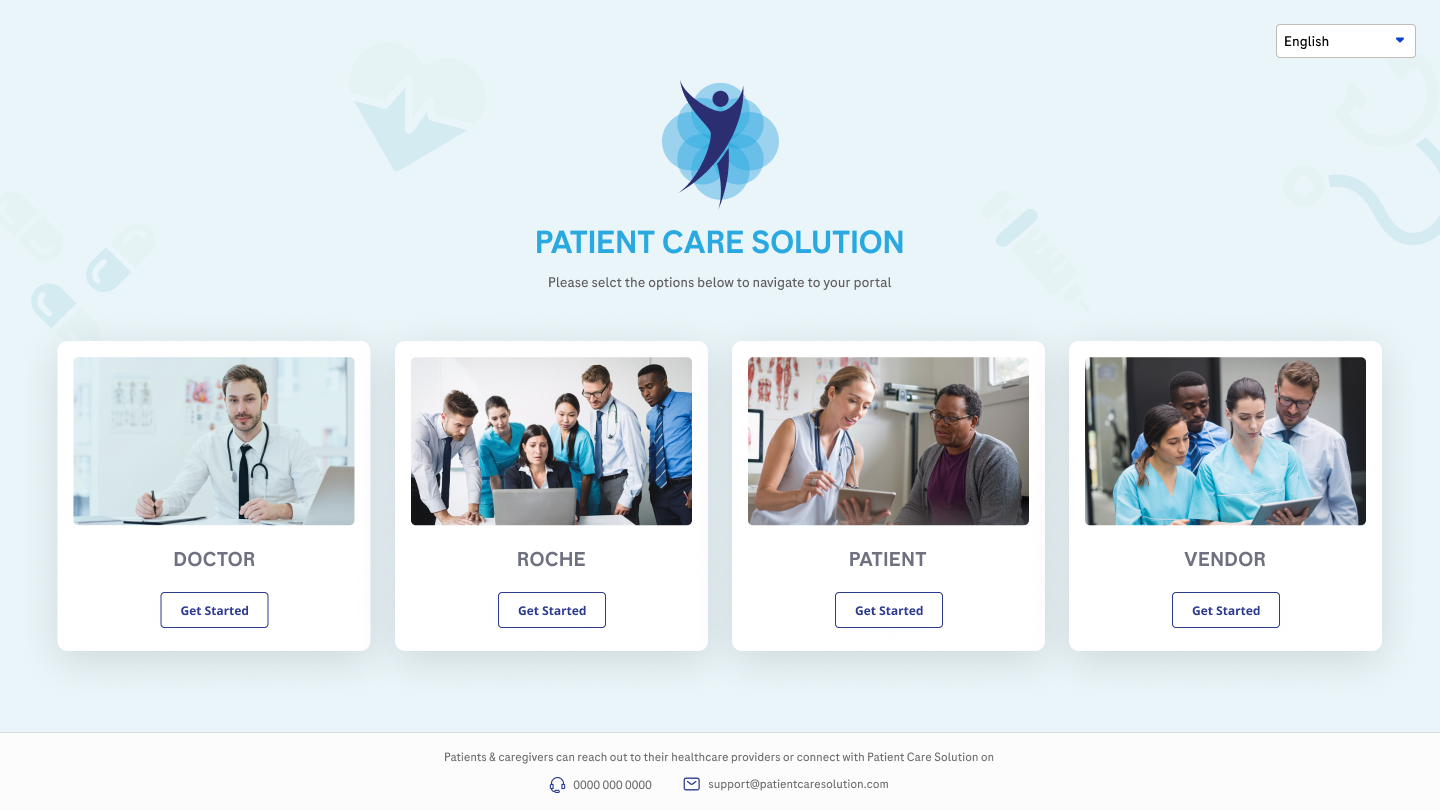
Doctor · Roche · Patient · Vendor: Role-based entry

Role-based entry

Recognition over recall

Four clearly named entry points help people choose their workspace. Language selection sits before sign-in, where it can support the first interaction.

Product Overview Walkthrough

See the product in motion.

This walkthrough shows a near-production version of Roche PCS Singapore Phase 2, which was shelved and not released. The overall product follows a similar experience.

PCS Design System Overview

One visual language. Many roles.

The PCS design system brings a consistent visual language to role-specific workspaces. Shared interface patterns help people recognise familiar actions and navigate complex patient-care workflows. Explore the foundations and components in this walkthrough.

Global Footprint & Outcomes

Patient support across borders.

PCS launched across 16 markets, coordinating medicines, diagnostics, and support services for patients on long-term therapy. A shared platform connects programme teams while adapting to local delivery needs.

16

Named markets

~150K

Patients served worldwide

Across all global markets to date.

A shared programme model, adapted to the people, service partners, and operating conditions in each market.

South & Southeast Asia
IndiaBangladeshIndonesiaMalaysiaThailandSingaporePhilippines
East Asia
TaiwanHong Kong
Oceania
AustraliaNew Zealand
Europe
Belgium
Americas
CanadaMexicoBrazilArgentina

A platform designed to keep care moving.

Shared visibility

One view of work across organisations.

Accountable routing

A defined owner and next step for every request.

Safer operations

Safety review embedded in the service flow.

Configurable scale

A common core that can meet local needs.

Continue exploring

Explore other projects.

Browse more product design work across complex systems, emerging technology, and high-impact experiences.

View all projects
Let’s Talk

Let’s createimpact together.

I’m a Product Design Manager and Consultant open to complex products, strategic challenges, and high-impact collaborations. Whether you have a project, idea, or just want to say hello — I’d love to connect.

Built on real problems, not just pixels.

Karthik Rahul’s Toptal badge
01Direct conversation

Priority DM

Connect directly to discuss UX, AI, product strategy, and what's next.

DM Now
03Let’s connect

Connect Socially

Follow or connect. Let’s turn conversations into collaboration.